

Stainless Steel Hex Bolts Company Buying Guide for Durable Fastening Solutions
2026-11-21
When a bolted connection fails, the cost is rarely limited to the fastener itself. Stainless steel hex bolts sit at the center of that risk, balancing corrosion resistance, tensile strength, and long-term service in environments that punish ordinary hardware. But not every stainless hex bolt on the market earns its place in a critical assembly. This guide from Wanluo cuts through the spec-sheet clutter to show what actually matters: raw material quality, dimensional consistency, and the finishing details that separate durable fastening solutions from expensive field failures. Before you place another order, here is what your supplier may not be telling you.
What the Grade Markings on a Stainless Hex Bolt Won't Tell You
A stamped A2-70 or A4-80 tells you the alloy family and a minimum tensile strength, but it leaves out how the bolt will actually behave once it is installed. That marking is a material declaration, not a performance promise for your specific joint.
Corrosion resistance is one of the biggest blind spots. Two bolts marked A4 can behave very differently in coastal or chemical exposure depending on surface finish, passivation quality, and whether the cold-heading tooling left microtears or embedded carbon steel particles.
Other details stay off the head entirely: thread class, hydrogen embrittlement risk from cleaning or plating, magnetic permeability, and dimensional consistency from one batch to the next. The grade marking is useful shorthand, but it works more like a rough material label than a complete engineering profile.
Choosing Between A2-70 and A4-80 Without Paying for Overkill
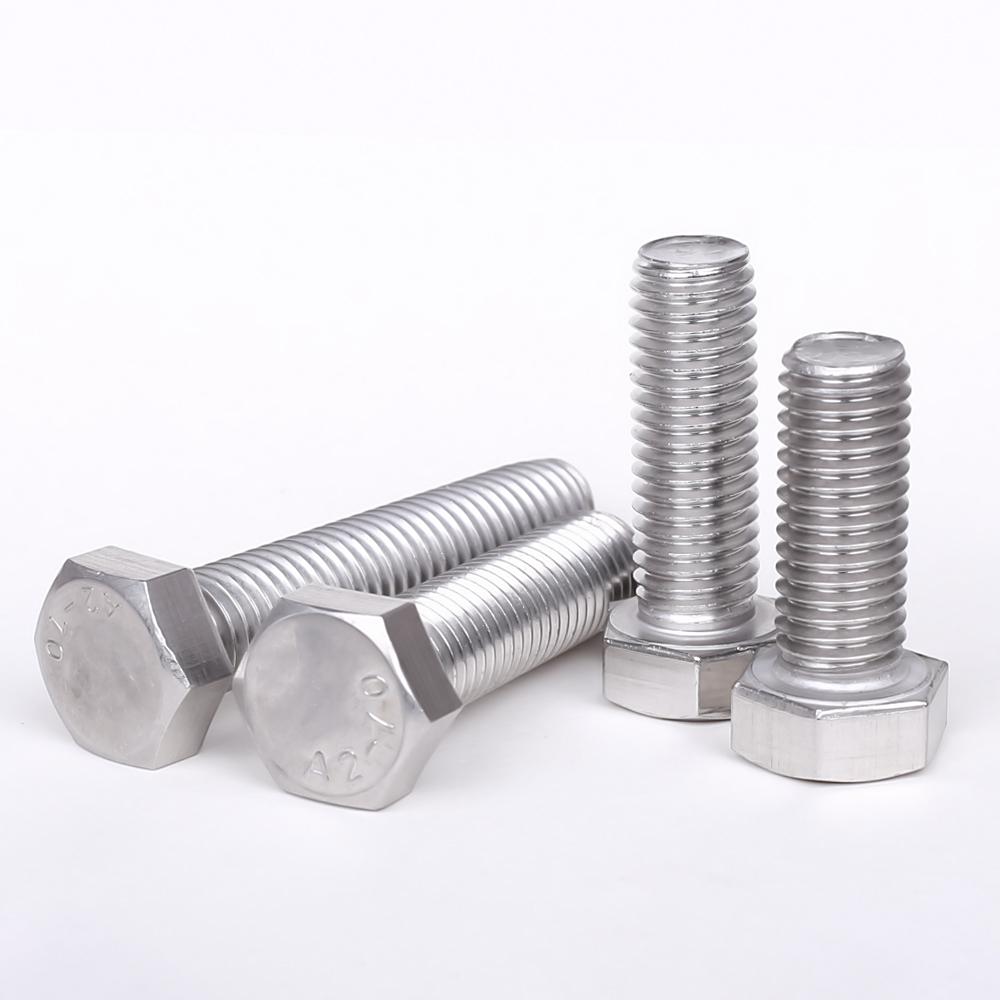
A2-70 earns its keep in dry, indoor, or lightly sheltered settings. Unless the assembly sits near the coast, gets hit with de-icing salts, or runs through aggressive washdowns, the higher strength of A4-80 rarely changes how the joint behaves. Paying for that upgrade on standard equipment cabinets, HVAC mounts, or interior bracketry is a classic case of buying headroom that never gets called on.
The decision flips once chlorides enter the picture. A4-80 is not just a stronger fastener; its molybdenum-bearing stainless chemistry resists the pitting that quietly destroys standard 304-type hardware in marine or chemical environments. If failure means teardown, safety exposure, or frequent replacement in a salt-laden area, the extra cost stops looking like overkill and starts looking like cheap insurance.
A simple filter works for most projects: if you are not fighting chloride corrosion and the stress stays below the A2-70 limit, use A2-70. Save A4-80 for joints that live outdoors near salt, handle repeated washdowns, or cannot be inspected often. Matching the grade to the actual exposure keeps the specification lean instead of letting a higher number drive the budget.
The Same Few Places Cheap Hex Bolts Tend to Fail
Spend enough time under a car or inside a machine enclosure and you start to recognize the familiar break points. Cheap hex bolts rarely fail in the threaded length where stress is evenly distributed. Instead, the head pops off just below the bearing face, or the shank cracks across the first thread root after the unthreaded grip. These are the zones where the rolled grain has been interrupted, the root radius is tightest, and the plating process has left a thin, brittle skin.
The worst offenders are usually the ones with a sharp transition under the hex head. A well-made bolt uses a generous radius there to spread the load; the budget version gets a shallow, almost square corner that acts like a notch. Tighten it against a bracket that flexes, and every vibration starts working that notch until a fatigue crack grows inward from the surface. The failure often looks sudden, but it has usually been running for hundreds of cycles.
Hydrogen embrittlement also hides in the same repeat locations, especially on fasteners with a bright zinc finish done fast and cheap. The trapped hydrogen concentrates near the head-to-shank junction and the thread runout, so those are the places that shear with very little warning. If you want to avoid chasing the same broken stubs, look for bolts with rolled threads, a visible fillet under the head, and a coating process that does not invite hydrogen into the steel.
Questions Worth Asking a Supplier Before the Order Leaves the Dock
Before you sign off on the final paperwork, it pays to slow down and check the details that rarely make it into the contract. Ask whether the cartons are actually rated for ocean freight, not just a domestic truck route, and whether anything inside is sensitive to humidity or rough handling. A quick request for photos of the pallets as they are wrapped, the labels stuck on each carton, and the exact dimensions of every stack can catch problems while the goods are still on the supplier’s floor.
It is also worth confirming who packed the container and whether the count on the packing list matches what was physically loaded, not what the production sheet says. If the order includes custom colors, voltage, or printing, ask for a short video of the finished units running or laid out side by side. Finally, clarify how the supplier will handle shortages or visible damage discovered after unloading, because the answer you get before departure is usually far more useful than the one you get after a claim is already filed.
One more useful question is whether the supplier has booked the sailing with a carrier you actually recognize, and whether the documents you need for customs will be ready before the vessel arrives. Getting the bill of lading, commercial invoice, packing list, and any certificates into one place early saves a scramble later and gives you a clear point of contact if something changes at the port.
Thread Fit and Tolerances That Only Show Up During Assembly
A fastener can pass every bench check and still go tight halfway into a tapped hole. That gap between inspection and reality is where thread fit tolerances hide. Ring gauges and plug gauges confirm basic pitch diameter limits, but they don't reproduce the combined effect of lead error, flank angle variation, plating thickness, and slight misalignment that appears only when two real parts come together under torque.
Surface finishes and coatings often shift the effective pitch diameter just enough to matter. A zinc or phosphate layer may be allowed for on paper, but local build-up in the thread root or on the flanks can turn a Class 2A/2B fit into something closer to an interference fit. Long engagement lengths make it worse because small pitch errors accumulate over more threads, so a stud that starts easily may lock solid in the last few turns. Out-of-square tapping or a mating face that pulls the bolt slightly sideways produces the same kind of local high spots that no single-part gauge will catch.
On the line, the usual symptoms are erratic torque, fasteners that feel snug before seating, or a joint that reaches torque without clamping the parts. These are not random material problems; they are geometry and tolerance stack-ups that only become visible during assembly. A practical fix is to test a sample batch with the actual mating parts or a functional gauge that simulates the assembly condition, and to control pre-plating thread dimensions rather than assuming the coating will simply fill the clearance evenly.
A Repeatable Spec Sheet So Every Project Doesn't Start From Scratch
Most projects don't stall because the idea is weak. They stall because the first few days get eaten by the same questions that were answered last time, just in a different room with different people. A repeatable spec sheet removes that drag. It captures the decisions, constraints, and terminology that your team has already fought through once, so nobody has to quietly wonder whether a feature is in scope or whether a word means the same thing across departments.
The point isn't to turn every project into a rigid form. It's to keep the baseline steady while the actual thinking happens on the parts that matter. A good spec sheet lives somewhere between a checklist and a memory, holding onto things like dependencies, edge cases, and acceptance criteria without pretending the project is already solved. When the obvious stuff is already written down, the conversation can start further ahead.
Teams that rely on this tend to make fewer assumptions and revisit fewer decisions after the work has started. It also makes handoffs less fragile, because a new person can read the sheet and get oriented without pulling three other people into a meeting. The goal is simple: let the familiar parts stay familiar, and leave the real energy for the parts of the project that actually need it.
FAQ
Ask for material certifications and batch traceability before anything else. A supplier that can show heat numbers tied to the actual bolts, plus dimensional reports from each production run, is already ahead of one that only prints generic spec sheets. Also watch how they handle sample orders—if they can't send a small trial lot without friction, that tells you more than a polished catalog.
For coastal, marine, or chemical exposure, 316 or 316L is usually the safer call because the molybdenum content gives better resistance to chlorides. 304 works for most indoor and light outdoor use, but it can pit faster around salt or industrial fallout. If strength matters more than corrosion resistance, some companies look at 410, but that grade rusts more readily and needs a clear risk check.
Don't rely on the supplier's word or a stock photo. Request sample pieces from the actual production line and check them with go/no-go thread gauges, a caliper, and the relevant ISO or ASME standard. For larger runs, ask for first article inspection reports and agree on acceptable AQL levels so there's a shared standard if a dispute comes up.
Light magnetism on 304 bolts is common because cold forming can create some martensite, so it's not automatically a sign of bad material. But if a batch labeled 316 feels strongly magnetic, it's worth testing the alloy composition. For most structural uses, a slight magnetic pull on 18-8 grades doesn't mean the bolts will rust early.
Passivation should be standard after machining or cold forming because it removes free iron and lets the chromium oxide layer reform cleanly. Ask whether the bolts are passivated in-house or by a certified finishing shop, and avoid chasing coatings unless the environment specifically requires extra protection—most stainless failures come from contamination, wrong grade, or trapped moisture rather than a missing top coating.
Get the supplier to confirm whether the material is already on the shelf or still needs to be drawn from a mill. A low unit price means little if the raw stock isn't real or the lead time stretches past your install window. Ask for a written lead time with a clear production start date, and give preference to suppliers who stock the diameter and length you're ordering rather than promising to 'source it' after payment.
Insist on sealed, labeled bags or boxes that show size, thread pitch, grade, and the heat lot number. Mixed lots are one of the costliest hidden problems because a few wrong bolts can stop a whole assembly line. If you run multiple projects, ask for barcode labels or internal tags that match the supplier's packing slip exactly.
Most field failures trace back to using the wrong grade for the exposure, contamination from carbon steel tools, or over-tightening that causes galling between stainless threads. Chlorides can also sit in crevices and start pitting even on 316 if the design traps water. A realistic material choice and clean handling go further than paying extra for a vague 'marine grade' promise.
Conclusion
A grade marking on a stainless hex bolt tells you the alloy family, not how the fastener will behave under sustained load, salt spray, or repeated assembly cycles. The real buying decision usually comes down to matching A2-70 or A4-80 to the job rather than paying for overkill: A4-80 justifies its price in marine or chemical exposure, while A2-70 handles most outdoor and structural work without extra cost. Cheap stainless hex bolts rarely fail in the middle of the shank. They tend to break at the head fillet, the first thread, or the washer face, where rushed machining leaves stress risers that a marking or a mill certificate will not show.
Before an order leaves the dock, ask about thread fit, passivation, and whether the heat number can be traced to the mill. A bolt that turns smoothly in a fixture can still bind in a tapped hole or gall during assembly because thread tolerance was never checked against the actual mating part. Ask for a small pre-shipment sample and run it through the actual assembly, not just a thread gauge. The practical fix is a repeatable spec sheet listing thread class, finish, marking, mechanical properties, and lot documentation. Once that sheet exists, future orders stop becoming a fresh negotiation and become a known quantity that protects the assembly line.
Contact Us
Contact Person: Shane
Email: [email protected]
Tel/WhatsApp: 8613357785029
Website: https://www.wanluohardware.com
