

OEM Tubular Steel Poles Supplier Requirements for Reliable Infrastructure Projects
2026-11-18
Every reliable infrastructure project starts with components that rarely get the spotlight but quietly carry the entire load. Tubular steel poles are exactly that: the backbone of stable power lines, street lighting, and communication networks. Yet sourcing them is not simply about choosing the lowest bid. It means vetting an OEM tubular steel poles supplier for material consistency, corrosion resistance, load capacity, and long-term structural performance. For project owners and contractors, a single overlooked defect can turn into costly delays or safety risks after installation. That is why Anbang focuses on engineering precision and repeatable production standards, helping infrastructure teams move from design to deployment with fewer surprises. This guide breaks down the requirements that matter most when evaluating a supplier, so your next project is supported by poles built to perform in the real world, not just on paper.
Mill Certificates Are Only Useful When They Follow the Pole to the Site
A mill certificate means little if it sits in a project office while the poles are unloaded hundreds of miles away. Its real value shows up at the moment a receiver can hold the document against the physical material and confirm that the grade, coating, and dimensions match what actually arrived. Once the pole leaves the laydown yard, matching paper to steel becomes guesswork.
When the certificate travels with the pole or is attached to the delivery ticket, it becomes part of the receiving record instead of an afterthought. Inspectors can flag mismatched material before it goes into the ground. A missed coating detail or an incorrect grade is far easier to resolve at the truck than after installation.
A certificate that arrives later, or only lives in a shared folder, rarely gets compared to the product. It may still satisfy a checklist, but it cannot protect the project during a failure investigation or a warranty claim. If the document did not travel with the pole, the chain of custody is already broken.
Why Standard Coating Specs Fall Short in Coastal and Industrial Air
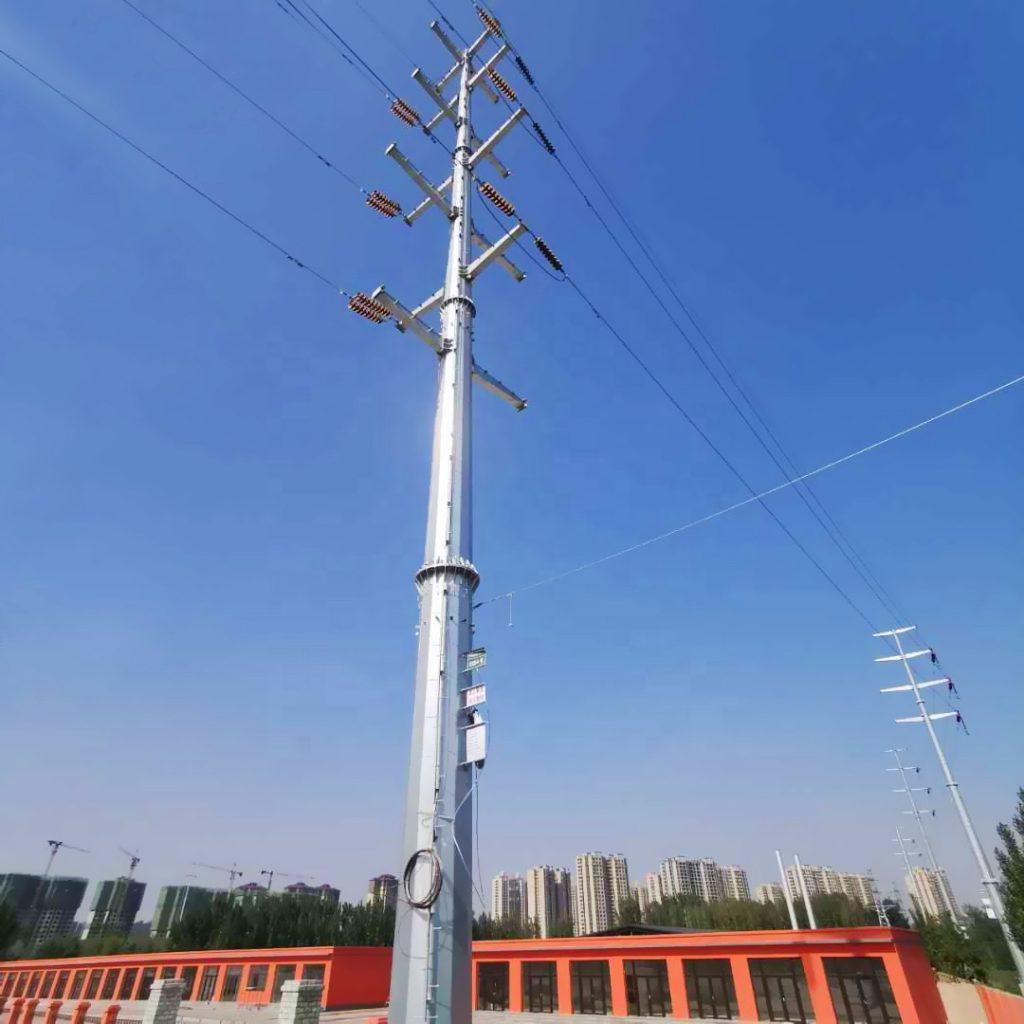
Most coating specifications lean heavily on generic salt spray or humidity cabinet results, but those benchmarks rarely mirror what happens when chloride-laden fog, sulfur dioxide, and ultraviolet exposure arrive in the same week. In coastal and industrial corridors, the coating is not facing a single stressor; it is cycling through wet and dry periods with corrosive salts trapped in surface pores, acid gases settling into crevices, and thermal expansion pulling at micro-cracks. A spec that checks a 1,000-hour fog test can still leave a structure vulnerable because it never asked how the system behaves under that specific combination.
Another shortfall comes from how thickness and adhesion are measured. Flat test panels reward uniform application, yet real assets include flanges, bolt heads, sharp edges, and drain points where coatings pull thin or cure unevenly. Standard specifications often set minimum dry film thickness without addressing edge retention or the way runoff collects contaminants at joints. In marine and heavy-industry settings, corrosion usually starts in those overlooked geometries, not on the broad, easily coated surfaces.
There is also a mismatch in expected maintenance intervals. Many generic specs assume a controlled inspection cycle and mild degradation rate that may hold inland but collapses near saltwater or chemical plants. By the time visible rust or blistering appears, the coating has already lost its protective integrity at the primer-to-substrate level. A more useful approach is to specify coatings based on actual exposure conditions—measuring time of wetness, prevailing wind direction, and distance from emission sources—rather than relying on a standard pass/fail result that was never designed for that environment.
Weld Flaws That Look Fine Until a Wind Load Finds Them
Most weld discontinuities hide in plain sight. A bead can appear full and neatly rippled while the throat depth falls short of what the joint actually needs, or while the edges never truly fused to the parent metal. Under normal service loads, the surrounding steel often carries the stress, and the flaw stays dormant. But wind changes the equation, introducing repeated cycles of tension and compression that search out the stiffest discontinuity and start working it like a hinge.
Wind loading rarely arrives as a single clean push. Gusts, vortex shedding, and the rhythmic sway of a structure turn what looks like a static bracket connection into a fatigue problem. Porosity, cold lap, and incomplete root penetration that would pass a routine visual check become crack initiation points when the structure flexes. The crack may start small, invisible under paint or galvanizing, then widen over hundreds of cycles until the remaining sound metal is no longer enough for one strong gust.
The dangerous part is the delay. A flawed weld can survive fabrication tolerances, fit-up stress, and even years of dead load without complaint. The first real test may arrive during a storm that exposes the joint to oblique uplift, suction, or twisting it was never quite prepared for. By then the margin is already spent, and the failure tends to happen at the worst possible moment—when access is limited, the wind is still blowing, and the crack has already outrun the inspection schedule.
How Custom Orders Stay Efficient When They Build on Proven Profiles
Nearly every custom order starts with a familiar tension: the client wants something tailored, but the production floor needs predictability. The trick is to stop thinking of "custom" as starting from zero. When a design team leans on profiles that have already survived thousands of runs, they inherit a quiet library of known tolerances, tooling footprints, and assembly rhythms. A bracket shape or a frame extrusion that has been through real-world use carries fewer surprises, so the custom portion narrows to the parts that actually benefit from attention—lengths, connection details, finish choices—rather than every millimeter of geometry.
What makes this efficient is not just reusing drawings. It is the downstream effect: operators recognize the profile, jigs already exist, and material forecasts become less like guesswork. The custom order stops being a prototype and starts behaving like a variation on a theme. That subtle shift changes how everyone quotes it, schedules it, and handles the inevitable last-minute tweak. Instead of re-engineering from the ground up, the team adjusts a few dimensions and keeps the rest of the workflow intact.
There is also a practical honesty to this approach. A proven profile has already absorbed the lessons that no CAD model teaches—how it behaves under load, how coatings wear, where tolerances drift over time. Building on that base means the custom order inherits those lessons for free. The efficiency is not about cutting corners; it is about refusing to relearn what the shop already knows, so the new part of each order gets the time and skill it actually deserves.
Packaging Mistakes That Undo a Factory Finish Before Installation
Even a flawless factory-applied coat can be wrecked before it reaches the room where it will be installed, and the cause is rarely the coating itself. One of the most avoidable issues is direct contact between a finished face and recycled corrugated board or low-grade foam. During transit, constant micro-vibration turns that contact point into sandpaper, leaving faint scuffs that stay invisible until the protective wrap comes off under bright job-site lighting. Another common problem is sealing coated parts too soon. When a still-curing panel goes into non-breathable film, trapped moisture has nowhere to go, so it works its way into the topcoat and leaves a milky haze or soft rub-off spot that can be mistaken for a product defect.
How pieces are stacked inside the box matters just as much as the outer material. Finished panels laid flat with only a thin slip sheet between them often rub along their edges as the truck moves. That friction can burn through a clear topcoat at the exact corners the installer handles first, leaving a raw-looking line that no touch-up pen can truly hide. Loose hardware packed in the same bag or compartment makes things worse. Hinges, mounting plates, and screws bounce against painted surfaces, chipping the edge before the primary wrap has even failed. Once that chip appears, the rest of the packaging becomes irrelevant because the piece already needs rework.
The simplest checks usually prevent the most expensive callbacks. Acid-free interleaving is worth the added cost, especially between dark colored faces and any paper product. Keep vapor barriers away from film that has not fully cured, and give metal components their own sealed pouch instead of letting them share space with finished surfaces. A quick drop test using the actual carton, not a sample mock-up, reveals how much movement happens inside. If the finish is being treated like a raw board during shipping, the packaging is undoing all the control the production line worked to achieve.
What Past Utility Work Reveals About a Supplier's Long-Term Reliability
A supplier's track record on previous utility projects often tells you more than a polished bid ever will. Pull the completion reports, change orders, and maintenance requests tied to work done three, five, or even ten years ago. The same intersection opened twice in two years, a patch that settled below grade, a splice that failed after one freeze-thaw cycle: these are small signatures of how seriously a crew treats underground work when no one is watching.
Material handling habits also leave a paper trail. Look at whether the supplier consistently used the specified bedding material, kept moisture out of conduits, or documented as-built conditions accurately. Shortcuts rarely appear as dramatic failures on day one. They surface later as premature corrosion, repeated outage calls, or unexplained voltage drops that eat into maintenance budgets and public patience.
Pay attention to the people who keep showing up. When the same foremen, splicers, and project managers remain with a supplier across multiple utility contracts, lessons tend to stick. They remember where old lines were laid, which manholes have groundwater issues, and why a certain feeder was rerouted. That continuity is hard to fake and is often the difference between a supplier that simply finishes a job and one that stands behind it for the life of the asset.
FAQ
A qualified supplier brings in-house engineering, controlled welding procedures, and traceability from raw coil to finished pole. They typically maintain certified welders, document heat numbers, and run their own galvanizing or have a locked quality agreement with a dedicated galvanizer. Without that level of control, dimensional consistency and long-term coating performance become harder to guarantee.
Ask for steel grades tied to project loads rather than generic 'commercial quality' claims. Common references include ASTM A572 Grade 50/55, A595 tapered tube specs, or EN 10025 equivalents. Confirm yield strength, elongation, and chemical composition are backed by mill test reports for each heat. Also check whether the supplier accepts third-party inspection of incoming coils.
Look beyond 'hot-dip galvanized' as a checkbox. Require coating thickness to match ASTM A123 or ISO 1461 for the pole section, plus repair procedures for field welds and damaged areas. In marine or industrial zones, a duplex system, galvanizing plus a high-solids epoxy or polyurethane topcoat, often makes more sense. Ask for salt spray or cyclic corrosion test data rather than just a warranty statement.
A dependable OEM supplier can review pole loading, foundation reactions, and deflection limits instead of simply building from a sketch. They should be able to run PLS-POLE or similar structural calculations, identify anchor bolt conflicts, and propose slip joints or flange details that match transport and erection constraints. This reduces redesign loops and keeps the project schedule intact.
Request a pre-shipment package that includes dimensional inspection reports, weld procedure qualifications, coating thickness measurements, mill certificates, and a signed certificate of compliance. Photographic evidence of fit-up, welding, and coating stages is useful for dispute resolution and for owner records. If the supplier is reluctant to share these documents, treat that as a red flag.
Standard lead times for OEM tubular steel poles often run 10 to 16 weeks depending on galvanizing volume and customization. Buyers can protect the schedule by freezing design data early, allowing the supplier to reserve mill capacity, and approving coatings or color samples before production begins. Avoid late changes to pole heights or accessory placements because they tend to cascade through structural calculations and fabrication drawings.
Look for sufficient press brake or rolling capacity to form the required pole diameters, welding stations with qualified procedures, and a galvanizing kettle long enough to handle the full pole section without progressive dipping issues. On-site storage space and crane reach matter too. Ask the supplier to walk you through a current project of similar complexity rather than just showing equipment lists.
Field performance shows how the supplier handles real conditions such as thermal movement, vibration, handling damage, and coating repair. Request references from projects with similar loads and environmental exposure, then ask about failures or punch-list items and how they were resolved. A supplier that discusses lessons learned honestly is more likely to deliver dependable infrastructure assets.
Conclusion
A mill certificate only matters if it actually travels with the pole to the job site. Suppliers who attach traceability to the delivery paperwork, not just to a file in the office, make life easier when questions come up later. Coastal and industrial environments also expose coating specs that are too generic. Standard galvanizing often thins first around base plates, brackets, and weld seams, and once corrosion starts there it spreads under the coating. A dependable supplier will talk about surface prep, cure times, and repair kits more than a single test report.
Weld flaws are easy to miss on a clean, smooth pole, but wind loads have a way of finding them. That is why weld procedures, operator qualifications, and cut tests matter more than a final visual check. Custom work stays efficient when a supplier uses proven pole profiles and changes only what the project actually needs, which keeps engineering and production time down. Packaging is the last risk before delivery; scratched coatings, dented slip joints, and missing caps can undo weeks of factory work. Long-term reliability shows up in a supplier's utility history, where repeat orders, low failure rates, and candid responses to field problems carry more weight than a polished first shipment.
Contact Us
Contact Person: antor khan
Email: [email protected]
Tel/WhatsApp: 8613863903569
Website: https://www.qdabtower.com/