

Cooling Gel Mattress Topper Supplier Reveals How to Choose the Right Topper for Deeper Sleep
2026-11-25
Most people blame their mattress for restless nights, but the real problem often sits right on top of it. A cooling gel mattress topper can be the difference between waking up overheated and finally getting the deep sleep you keep chasing. Kunbao has spent years supplying these toppers, and the patterns are clear: choice matters more than hype. Here’s what actually separates a topper that works from one that just adds padding.
When Your Mattress Holds Heat Before the Topper Can Work
A cooling topper can only do so much when the mattress underneath is the real heat source. Dense memory foam or aging polyurethane holds onto body warmth long after you shift position, and that stored heat creeps upward through even the most breathable topper layers. You end up with a cool surface at first, followed by a slow build-up of warmth that seems to come from nowhere.
Some mattresses are simply too thick or too tightly packed to let air move through the lower support layers. When your body weight compresses the topper into the mattress, the gaps that would normally carry moisture and heat away get pinched shut. This turns the area under your hips and shoulders into a warm pocket that lingers for hours.
If the mattress has been in use for several years, the foam cells may have collapsed enough to trap heat instead of releasing it. A new topper can mask that problem briefly, but the trapped warmth eventually makes its way back to the surface. In those cases, improving airflow around the bed or addressing the base mattress makes a larger difference than switching to a thicker topper.
Gel Infusion Patterns Matter More Than Gel Type
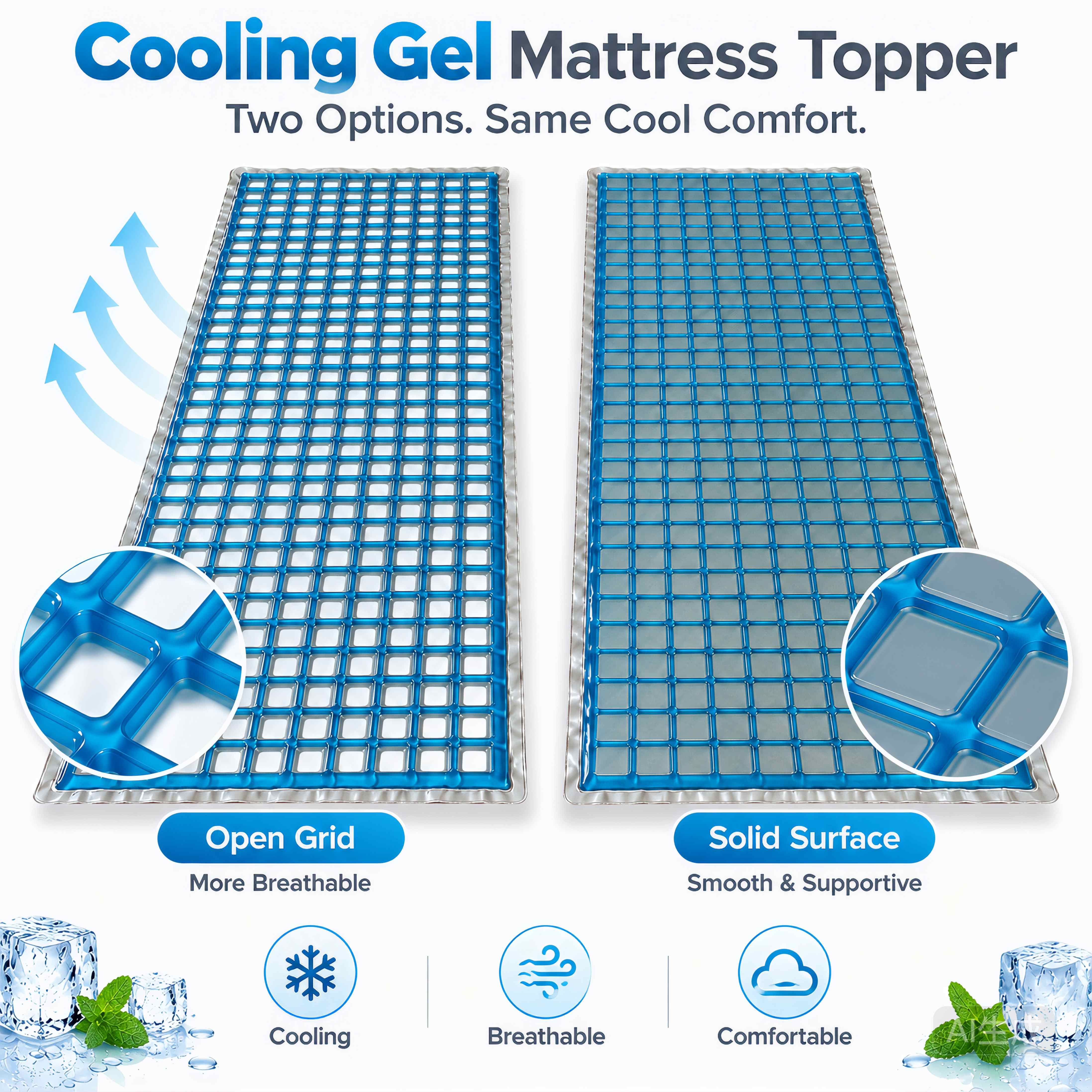
A gel’s reputation usually starts with its chemical family, but once it is inside a product, the way that gel is arranged does the heavy lifting. A continuous sheet, a grid of small dots, a honeycomb fill, or diagonal channels each redistribute load, heat, and rebound differently. Change the layout and the same gel can feel firmer, cooler, or noticeably more stable.
That is why two items with nearly identical gel formulations can feel nothing alike. One may use thin vertical columns that collapse quickly under weight, while another uses wider pods that hold their shape longer. The material itself is only half the story; the spacing, depth, and flow path of the infusion shape how pressure is absorbed and how quickly the surface recovers. If a design needs more support, adjusting the pattern often beats reformulating the gel.
The practical takeaway is to look beyond the ingredient label. Ask how the gel is mapped across the contact area, whether it is segmented for airflow, and where the denser zones sit. Those structural decisions usually have a greater impact on comfort, temperature control, and durability than the named gel type alone.
Why Thicker Toppers Sometimes Sleep Warmer
A thicker topper tends to hold onto more body heat simply because there is more material between you and the mattress. That extra foam or fiberfill creates small pockets of still air, and still air is a surprisingly good insulator. As your body warms the top layer, the heat doesn't have a straight path downward, so it lingers around your shoulders, hips, and legs instead of seeping into a cooler mattress.
Density plays a bigger role than thickness alone. Some plush toppers trap warmth in the upper layer without letting moisture escape, which can feel stifling by early morning. Others use open-cell foam or channeled fiber to let warm air move outward while still cushioning pressure points. That difference explains why two toppers with the same stated thickness can feel completely different at 3 a.m.
The season and your bedding also shift the equation. A thick topper under breathable cotton sheets may sleep cool enough in winter, but under a heavy duvet it can tip into overheated territory. If you tend to run warm, look for thickness paired with ventilation rather than assuming every plush option will trap heat.
The Cover Fabric Is the Real Cooling Gatekeeper
A cooling layer can only do its job if the surface above it lets heat leave. Dense covers with a smooth synthetic face often hold warmth right against the skin, while an open-knit fabric gives it a way out. Before worrying about gels or copper, it helps to check what is actually touching you.
The feel of the cover is not just about softness. Quilted or plush tops can create a thin warm pocket around the body even when the room stays cool. A flat, breathable knit with natural fibers tends to feel cooler simply because it interrupts that pocket and allows a little air movement.
When heat cannot escape through the cover, the materials underneath become far less relevant. This fabric is the true gatekeeper because it decides whether warmth lingers at the surface or moves away from the body. Paying attention to it is usually a simpler and cheaper fix than chasing another cooling layer.
Your Sleep Position Changes Which Loft Feels Right
Side sleepers usually need a higher loft to keep the neck aligned, because the shoulder creates a gap between the head and the mattress. A pillow that’s too flat lets the head tilt downward, while an overly firm one can push the ear toward the shoulder. The sweet spot often falls in the medium-to-high range, though the exact height depends on shoulder width and mattress firmness.
Back sleepers tend to do best with a medium loft that supports the natural curve of the neck without thrusting the chin forward. Too much height can flatten the airway and cause snoring, while too little leaves the neck unsupported. Stomach sleepers, on the other hand, usually need the lowest loft available, sometimes even no pillow under the head, to keep the spine from arching.
Rather than treating loft as a fixed number, think of it as a range that shifts with your dominant position. If you switch between side and back during the night, a slightly lower side-sleeping loft often works as a compromise. Testing with a towel under your current pillow is a quick way to approximate different heights before committing to a new one.
What Changes After the First Thirty Nights
The first week or two on a new sleep surface rarely feels settled. Your body is still mapping the edges, noticing how much give the foam has, where the firmest zone sits under your hips. By the thirty-night mark, that background awareness mostly fades. You stop bracing slightly before turning over, and the mattress stops feeling like a separate object in the room.
What tends to shift is less about the bed itself and more about how you wake. The small adjustments you used to make all night—flipping the pillow, searching for a cooler patch, shifting weight off one shoulder—become less frequent. A full sleep cycle has room to run without interruption, and that starts showing up as steadier energy in the early afternoon rather than a sharp crash.
There’s also a quieter change in routine. Getting into bed begins to signal the end of the day more reliably. Lights off feels less like a gamble and more like a repeatable rhythm. Whatever lingering doubts about the choice usually quiet down after those first thirty nights, replaced by a preference you don’t think about much anymore.
FAQ
Start with the density of the foam rather than the marketing claims. A denser core, usually above 3 pounds per cubic foot for memory foam, holds the gel better and is less likely to sag after a few months. Then look at how the gel is distributed. Surface-infused gel wears down faster than gel beads mixed through the foam, so ask about the construction, not just the cooling label.
It changes pressure relief more than temperature. A 2-inch topper gives you the cooling feel without changing the bed's firmness much. A 3- or 4-inch topper allows more sink, which can trap body heat if the foam is too soft. So for hot sleepers, I usually recommend staying close to 2 or 3 inches with a firmer gel foam, because deeper sink often cancels out the cooling benefit.
Not all. Some are treated with chemical cooling finishes that can irritate sensitive skin. You want a topper with a removable, washable cover made from natural or hypoallergenic fabric, and a foam core that is CertiPUR-US certified or similar. That certification means low VOC emissions. If you are very sensitive, air the topper out for 48 hours before use.
Side sleepers with hip and shoulder pressure tend to benefit most, because the gel foam softens those pressure points while the cooling surface helps with night sweats. Back sleepers do well too, but they need a medium-firm density so their lower back doesn't drop. Stomach sleepers should be cautious: a thick, soft topper can overextend the spine. For them, a thin, firmer option works better.
Expect around 3 to 5 years with daily use. The cooling effect itself usually remains noticeable for 2 to 3 years. When the surface starts showing body impressions that don't bounce back within a few hours, it's time to replace. Rotating the topper every month or two can extend its life, but not all toppers are designed for flipping—check the label first.
Never soak it or put the whole topper in a washing machine. Spot-clean the foam with mild soap, cold water, and a clean cloth, then let it air dry completely before putting the cover back on. The cover itself can usually be machine washed on a gentle cycle. The main thing is to keep moisture out of the gel foam, because trapped dampness breaks down the structure and can lead to mildew.
That usually means the top layer is thin and the base foam underneath is dense, heat-trapping memory foam. Once your body warms the thin gel layer, there is nowhere for that heat to go. A breathable cover and an open-cell foam core make a bigger difference than extra gel. If possible, choose a topper with perforated foam or ventilation channels rather than a solid slab.
Not by itself. You are paying for foam density, gel quality, and the cover material. A cheap topper can feel cool in a showroom but fail after six months. A very expensive one may simply have a thicker cover or brand markup. Compare density, thickness, and cooling method instead of price. A mid-range topper with gel beads and a breathable cover often outperforms a premium surface-coated model.
Conclusion
A cooling topper can only do its job when the mattress underneath isn't holding excess heat, so the first step is evaluating how warm the bed feels before adding any layer. Gel infusion patterns tend to shape performance more than the type of gel itself; an even or channeled layout draws heat away without creating stiff spots, while a scattered gel swirl may leave warm patches. Thicker toppers sometimes sleep warmer because added foam traps body heat, so extra loft is not automatically better. Your preferred sleep position also changes the right height, side sleepers often need more cushion for hips and shoulders, while back and stomach sleepers usually settle into a lower profile more comfortably.
The cover fabric is the real cooling gatekeeper because a dense, non-breathable shell blocks air from reaching the gel layer even when the core material is well designed. Look for covers that stay cool to the touch and allow moisture to escape rather than relying on fiber content claims alone. After the first thirty nights, the surface may soften and show slight body impressions; this is normal, but if it starts feeling sticky or consistently warm, the problem is usually airflow or loft mismatch rather than a lack of gel. Rotating the topper as directed and paying attention to whether it sleeps neutral rather than icy will help you judge whether it truly supports deeper, more comfortable rest.
Contact Us
Contact Person: Catherine Peng
Email: [email protected]
Tel/WhatsApp: +86-13434169510
Website: https://www.kbcoolgel.com/
