

SiC Wafer Boat Manufacturer: What Engineers Need to Know
2026-11-02
Selecting the right SiC wafer boat manufacturer can make or break your high-temperature process. From thermal shock resistance to contamination control, the details matter more than most engineers expect. This guide cuts through the noise, covering the critical factors you should evaluate—and why Semicorex has become a trusted name for production-ready solutions.
Reading Between the Lines of SiC Purity Specs
The headline number on a SiC datasheet rarely tells the whole story. A “5N” purity spec may sound reassuring, but the analytical method behind it matters just as much as the percentage. Glow discharge mass spectrometry (GDMS) might catch most transition metals, yet it can underreport light elements like oxygen that sit stubbornly in the lattice. If a supplier only quotes metals, ask what assumptions are baked into that figure.
Doping is another place where purity specs get slippery. Unintentional nitrogen or aluminum can arrive with the raw powder or creep in during crystal growth, and their impact on resistivity far exceeds their ppm count. A material can meet a strict metals ceiling and still behave nothing like intrinsic SiC. That's why reading between the lines means checking whether the spec covers both intentional and unintentional dopants, not just the elements that are easy to measure.
Finally, pay attention to what's not on the certificate at all. Surface contamination from handling, packaging residue, or slight stoichiometry drift won't show up in a bulk purity analysis but will change how a wafer performs in your process. The most useful purity spec is one that aligns with how you'll actually use the material—not just a number that looks clean on a comparison table.
Why Thermal Gradient Uniformity Starts with the Boat
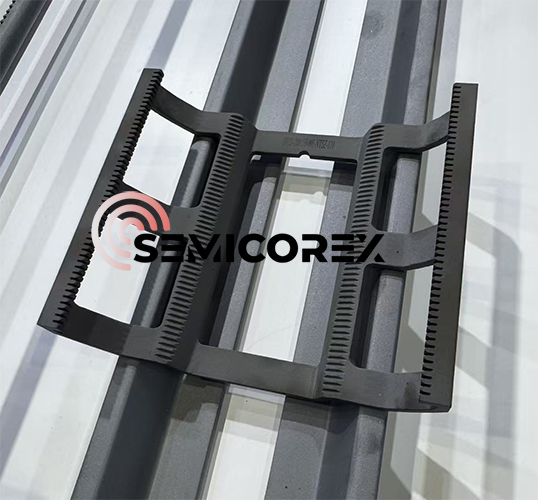
In a high-temperature furnace, the boat isn't just a carrier—it's the first surface that heat meets before it ever reaches your samples. If that carrier has uneven mass distribution or poor contact with the heating element, you'll see temperature deltas appear long before the process even stabilizes. The boat’s geometry, material thickness, and even its surface finish all shape how thermal energy flows across the load. A warped or oxidized boat can create localized hot spots or cold zones that quietly sabotage layer uniformity.
Think of it as the foundation of the thermal stack. Every sensor reading downstream is filtered through what the boat itself is doing—how it expands, how it stores heat, and how it releases it during ramp-down. Operators often chase after controller tuning or gas flow tweaks, but the real unevenness frequently lives right at the point of contact, where the boat rests on the susceptor or support rods. Small gaps there introduce variable resistance, and that variability gets baked into every wafer or substrate you process.
So before reaching for advanced multi-zone compensation, take a hard look at the boat. Is it flat along the entire seating surface? Has repeated thermal cycling altered its emissivity? These aren't cosmetic questions—they're the difference between a furnace that runs repeatably and one that drifts with every cycle. Uniform thermal gradients rarely survive a boat that can't decide how it wants to absorb and radiate heat.
Custom Slot Geometry: Avoiding Edge Contact and Microcracks
When a standard rectangular slot forces the mating component against sharp internal corners, the resulting stress concentration often initiates hairline fractures that spread slowly under cyclic loading. Adjusting the profile to include a slight radius at each end of the slot redistributes contact pressure away from those vulnerable edges, allowing the component to settle into a more neutral position. This simple change in geometry reduces the likelihood of microcrack formation without demanding tighter machining tolerances.
Beyond corner radii, the clearance along the slot's sidewalls matters just as much as the end profile. A custom taper, even of a fraction of a degree, can create a controlled contact band that prevents the part from rocking or wedging against a single edge. Softening the entry chamfer also guides the interface during assembly, so that the initial touch occurs on a prepared surface rather than a sharp boundary. These details keep local stress below the threshold where microcracks tend to nucleate in brittle platings or hardened substrates.
The Case for CVD-SiC Coated Boats Over Sintered
A graphite boat with a dense CVD-SiC shell behaves very differently in production than a monolithic sintered SiC carrier. The coated version keeps the forgiving mechanical properties of graphite—lower modulus, better machinability, and far greater resistance to thermal shock—while the SiC layer handles the harsh environment. Sintered SiC, by contrast, is extremely hard and brittle. Once a sintered boat develops a microcrack from uneven heating or accidental contact, that crack tends to propagate quickly, often ruining the entire carrier without much warning.
Thermal cycling is where the coated boat shows its clearest advantage. Graphite expands and contracts at a predictable rate, and the CVD-SiC film bonds tightly enough to follow those movements without spalling. Sintered SiC has almost no give; rapid ramp rates or slight temperature non-uniformity across the boat can generate enough internal stress to crack a corner or snap a slot wall. Operators who push aggressive temperature profiles usually find that coated graphite boats survive longer between replacements and produce fewer particle issues from sudden breakage.
There is also a practical side: complex slot geometries, deep pockets, and custom wafer pitches are much easier to machine into graphite before coating than into fully sintered SiC. If a design changes or a boat needs repair, recoating a graphite substrate is often feasible, whereas a damaged sintered boat is usually scrap. For many fabs, that combination of thermal resilience, contamination control from the CVD layer, and easier rework makes coated boats the more dependable choice over the long run.
Questions to Ask a Manufacturer Before the First Prototype
Before you commit to a first prototype, it's worth pinning down the manufacturer's expectations around design files, tolerances, and material options. Ask whether they prefer native CAD files or neutral formats like STEP, and clarify how they handle dimensional variances that might affect fit or function. This conversation can reveal whether their capabilities align with your part's geometry and whether they'll flag potential issues before cutting metal or molding plastic.
You'll also want to understand their prototyping process and what happens when something needs to change. Ask about typical lead times, how they inspect first articles, and whether they charge for revisions between prototype rounds. Find out if they have minimum order quantities that might force you into a larger run than you're ready for, and whether they can suggest alternative materials or manufacturing methods that reduce cost without sacrificing the critical features of your design.
Predicting Boat Lifetime: Data Points Engineers Overlook
Most lifetime models start with hull material, engine hours, and average salinity. But a boat that sits idle in a humid marina for eight months a year often degrades faster than one used weekly in open water. The overlooked data points are the quiet ones: bilge pump cycle counts during storage, condensation patterns inside cabin lockers, and the exact torque readings from through-hull fittings taken after each haul-out. These measurements rarely make it into a spreadsheet, yet they reveal how moisture, vibration, and neglect accumulate between the big service intervals.
Another blind spot is the owner's own logbook style. A skipper who records only fuel consumption misses the early warning signs buried in small maintenance notes, like "port seacock stiff again" or "slight rust streak under the water heater." Engineers can extract useful signals from these marginalia if they stop treating them as noise. The frequency of minor repairs, the time gap between noticing a drip and fixing it, and even the choice of cleaning products used on deck hardware all feed into a more honest lifetime prediction than thickness gauges alone.
Finally, the boat's microclimate matters more than regional averages. Two identical vessels moored fifty meters apart can age differently because one sits under tree shade that drops acidic leaves, while the other faces a prevailing wind that dries the topsides. Recording sun exposure by season, local water temperature fluctuations at the slip, and the type of bottom paint actually worn—not just the spec sheet version—gives a lifetime model the texture it needs. Without these granular details, any prediction is just a guess dressed up in engineering language.
FAQ
Start with the surface condition and slot geometry. Any roughness, micro-cracks, or uneven spacing tends to create local stress points on the wafers. Also verify that the material is fully densified and free of metallic inclusions, because these become contamination sources above 1200°C.
A heavy boat acts as a heat sink during ramp-up and can temporarily cool the center of the batch, so wafers near the edges may see different temperatures than those in the middle. Reducing unnecessary mass while keeping structural stiffness helps the furnace reach steady state faster and more uniformly.
Warpage usually comes from uneven thermal expansion combined with residual stress from the manufacturing process. If the boat is not properly annealed or if the slots are asymmetrical, repeated heating and cooling will gradually release those stresses as permanent deformation.
CVD SiC is much denser and purer than sintered SiC, so it gives a smoother, less reactive surface. This reduces particle shedding and slows oxidation, especially in aggressive cleaning steps that use halogen-containing gases.
Ask for data on thermal cycling, not just dimensional specs. A strong supplier will discuss slot design trade-offs, contamination test results from actual furnace runs, and how their material behaves after hundreds of cycles at your target temperature.
Slot pitch, flatness across the loading plane, and parallelism between uprights matter most. For 200mm wafers, even a few hundred microns of warp can lead to uneven contact and slip lines during ramping.
Monolithic boats avoid joint particles and are generally more stable, but they are expensive to replace when a single slot gets damaged. Modular designs allow partial replacement, yet joints must be checked for particle traps and looseness after thermal cycling.
Include material purity certification, surface roughness before and after simulated cleaning, thermal cycling to your maximum process temperature, particle counts on dummy wafers, and a dimensional check after cycling. Also request a small pilot lot run in your own furnace before full production release.
Conclusion
When evaluating a SiC wafer boat supplier, surface-level datasheets rarely tell the full story. Purity specifications demand a close look at trace metal concentrations, especially elements that volatilize during high-temperature processing—sodium, iron, and copper can compromise wafer performance well before total impurity counts exceed limits. Thermal gradients begin with boat design; uneven mass distribution or asymmetric slot placement creates temperature deltas that transfer directly into wafer stress. Custom slot geometry matters more than most engineers assume: rounded or relieved edges reduce point loading, while overly tight tolerances invite microcracks along the wafer periphery.
For high-volume production, CVD-SiC coated boats outperform sintered alternatives because the dense, high-purity coating resists particle generation and maintains dimensional stability after aggressive chemical cleaning. Before committing to a prototype, engineers should press manufacturers on process controls: how do they verify coating thickness uniformity, what is their rework policy for chipped slots, and can they supply batch-specific trace metal reports? Lifetime predictions go beyond simple cycle counts—data on slot wear, weight loss, surface roughness progression, and post-clean dimensional drift are often overlooked but critical for cost modeling. A supplier that openly shares this data is more trustworthy than one that hides behind glossy marketing.
Contact Us
Contact Person: Svenja Wei
Email: [email protected]
Tel/WhatsApp: +8613567891907
Website: https://www.semicorex.com