

Sanitary Ware Vertical Lift Plating Equipment Manufacturer Insights for Superior Bathroom Fixture Finishes
2026-11-02
Most plating lines struggle with the complex geometries of modern sanitary ware—until you see how vertical lift systems change the game. Junda has spent years refining this approach to deliver the kind of chrome depth and edge coverage that separates premium bathroom fixtures from the ordinary. Here’s what their engineering insights reveal about getting superior finishes without the usual headaches.
The Real Reason Vertical Lift Plating Suits Deep-Draw Bathroom Components
Vertical lift plating does more than just coat a surface—it reshapes how material flows into tight, awkward geometries. When you're pressing a deep-draw bathroom basin or a curved drain channel, conventional racks leave weak spots where the current crowds the edges and starves the center. Vertical lift changes that by suspending the workpiece so the plating solution moves with the draw, not against it. The result is a consistent thickness even where the metal has been stretched to its thinnest point, which means fewer rejects from cracked chrome or peeling nickel on the inside radius.
There's also a practical side that rarely gets mentioned: vertical lift systems cut down on handling and rack marks. In deep-draw parts, every scratch or dent from a horizontal fixture becomes a visible flaw once the high-gloss finish goes on. By holding the component upright, you eliminate the need for multiple contact points that normally leave tiny blemishes near the drain opening or the overflow slot. The plated surface comes out cleaner, so the final buffing step takes half the time—and the labor cost drops without anyone noticing.
Perhaps the biggest reason vertical lift works so well is how it handles the drainage problem. Deep-draw bathroom components trap liquid in their recesses, and if plating solution lingers there, it creates uneven deposits or stains that show up days later. Vertical orientation lets the chemistry run off naturally, so the recessed areas don't act as a sump. Platers who switch to this method often report fewer post-plating wash cycles and a sharper, more uniform luster across the entire part—especially inside those deep, narrow bowls where light and water are supposed to dance.
How Tank Turnover Rates Shape Final Chrome Depth on Faucet Bodies
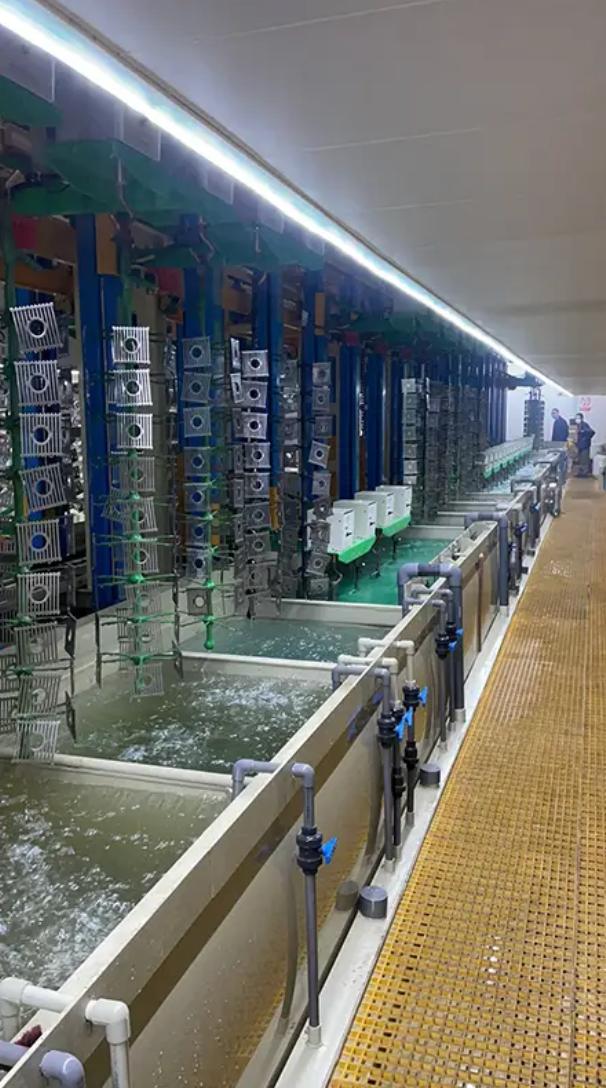
The link between tank turnover and chrome thickness is not always obvious at first glance, but it becomes clear once you watch the plating line operate over a shift. Turnover rate refers to how quickly the volume of solution in the chromium tank is replaced by drag-in and drag-out, or by deliberate additions. Faster turnover tends to keep the catalyst and chromic acid concentrations more uniform, which sounds beneficial, but it also means the bath has less time to settle into a stable chemical profile. On a busy production day, when faucet bodies move through the tank in dense racks, the turnover climbs and the final chrome depth can shift noticeably from morning to afternoon if no adjustments are made.
A slower turnover, by contrast, gives the bath a chance to build up a consistent working balance of trivalent chromium and sulfate. That stability usually favors a tighter distribution of deposit thickness across the surface of each faucet body. Yet too slow a turnover brings its own issues—contaminants accumulate, and the brightener breakdown products begin to interfere with the plating reaction. Platers often learn to read the turnover rate like a gauge: when it drops below a certain point, the chrome tends to deposit thinner on high-current-density areas like the spout edge, while low-current-density areas near the base may stay underplated and dull.
In practice, matching turnover to production volume without sacrificing thickness control calls for small, frequent additions of chromic acid and careful monitoring of bath temperature and current density. Some shops have found that a moderate turnover—around one full bath volume every eight to ten hours—keeps the chrome depth within a narrow tolerance band on faucet bodies. Others push turnover higher but compensate with a slightly elevated chromic acid concentration. Either way, the final chrome depth is not simply a matter of plating time or rectifier settings; it is shaped by how quickly the bath turns over and how well the line operator anticipates that rhythm.
Rack Design Choices That Prevent Shadowing in Tight Sanitary Profiles
In tight sanitary profiles, the way a rack contacts product surfaces often determines whether cleaning or coating media reaches every recess. The first practical choice is to replace broad, flat support rails with narrow, rounded contact points. A thin wire or an edge-ground pin touches far less of the profile, leaving adjacent surfaces exposed instead of blocked. This alone cuts the most common form of shadowing, where a wide support masks the underside of a flange or a groove and leaves residue behind.
Another effective measure is to angle the workpieces slightly instead of laying them flat on horizontal bars. Even a ten- to fifteen-degree tilt lets rinse water and air move across lower edges that would otherwise sit in a stagnant layer. Where parts must stay upright, spacing becomes the controlling factor. Profiles packed too closely create mutual shadowing regardless of how open the rack frame is, so designers often set minimum gaps based on the narrowest channel in the part. Finally, welded or fully rounded rack joints reduce crevices where fluid clings and then drips back onto a clean surface, which is a frequent source of recontamination in tight profiles.
A Closer Look at Drag-Out Control for Smoother Nickel Layers
Drag-out is rarely the first thing a plater blames for a rough deposit, yet it has an outsized role in how the nickel layer builds. Every part that leaves the bath carries a thin film loaded with nickel salts, brightener breakdown products, and suspended fines. If that film isn't pulled away evenly—through a recovery rinse, a well-angled air knife, or a long enough drip station—the next rinse dries some of it onto the surface. Those dried edges become nucleation points for nodules once the part returns to the nickel tank.
The usual answer is to add another rinse or slow the hoist, but drag-out control works best when it begins before the nickel bath. Residual oils, alkaline films, or hard-water spots from upstream cleaning increase the surface tension of the liquid and make drag-out cling more stubbornly. A low-pressure fog rinse right after nickel, followed by a counterflow recovery station, keeps the dragged-out volume small and the rinse water from spiking too fast. That stability allows the nickel bath to stay within its brightener and wetter working window, which translates directly into flatter, glossier deposits.
There's also a timing and temperature side that gets overlooked. Letting the drag-out film cool on the rack before rinsing can force some organic additives out of solution, leaving a tacky residue that resists normal washing. Keeping the first rinse at or just below bath temperature prevents that shock. Tracking the rise in conductivity or nickel concentration in the first rinse gives an early warning when drag-out creeps upward—often weeks before roughness appears on the parts.
What Plating Line Engineers Prioritize Before Installing Vertical Lift Equipment
Before any vertical lift equipment goes onto a plating line, engineers tend to focus on load stability and duty cycle. It is not just about lifting capacity on paper; the real concern is whether the hoist can handle the weight distribution of racks, barrels, or flight bars without swaying when dipped into aggressive chemistries. They also look at how often the lift will cycle, because intermittent use and continuous indexing put very different strains on motors, brakes, and wire ropes.
Clearance and control integration usually come next. Engineers measure overhead space, trolley travel paths, and tank edge distances to avoid collisions with exhaust hoods, bus bars, or existing monorails. They also check whether the lift can communicate with the line’s PLC or hoist controller without adding excessive latency. Making sure the equipment can be locked out safely and serviced without shutting down the whole line tends to be the final deciding factor before a purchase is approved.
Matching Vertical Lift Cycles to High-Gloss Bathroom Finishes Without Rework
High-gloss bathroom finishes leave very little room for error. Any deviation in a vertical lift cycle can introduce micro-dust, uneven temperatures, or solvent trapping that shows up as haze or orange peel on a mirror-like surface. Instead of treating the lift cycle as a fixed mechanical step, it makes more sense to view it as part of the finishing environment. Slower vertical travel with staged acceleration often helps, because sudden starts and stops stir up particles that settle invisibly on the wet gloss layer.
The real trick is synchronizing lift movement with the curing profile of the coating. High-gloss systems usually need a short flash-off window before the main cure. If the vertical lift carries a freshly coated panel through an area with even mild airflow, the surface can skin over too early or trap solvents. Matching the cycle means adjusting dwell positions and lift speeds so the panel reaches the controlled cure zone only after the coating has stabilized. This approach sidesteps the usual rework loop of sanding and re-spraying.
A practical way to lock in the right parameters is to run a small matrix of test panels under different lift profiles and inspect them under angled lighting. Look for micro-pitting, edge buildup, or gloss variation across the panel. Once the vertical lift cycle is matched to the finish, changing batches or ambient conditions rarely forces you to start over. Instead, you get a repeatable path from raw part to finished high-gloss surface without touching it again.
FAQ
Vertical lift lines give you controlled immersion and withdrawal angles that prevent air pockets and uneven drainage on deep-drawn shapes like basin bowls or toilet tanks. Instead of tumbling parts in a barrel, each fixture is fixtured individually, so current distribution stays more predictable. That reduces burning on edges and thin spots inside recesses. For larger sanitary ware pieces, the vertical stroke also allows longer exposure times without crowding, which means fewer rejects and less manual rework.
They focus on anode placement and pulse rectification, not just the hoist cycle. By positioning conforming anodes closer to recessed areas and adjusting current ramp-up in stages, you avoid the kind of edge build-up that ruins a mirror finish. Some builders also use custom shields or thieves to pull excess current away from high-current-density zones. The result is a more uniform nickel-chrome layer, even on square shower drains or angular faucet bodies.
Look beyond the frame and tanks. Ask about their experience with sanitary ware specifically, because fixture geometry differs a lot from automotive or hardware parts. Check whether they provide process development support, including bath formulation and racking design. A supplier that installs the line and then walks away is not much help. You want someone who will run test pieces, adjust rectifier settings, and train your operators until the finish passes your own adhesion and thickness specs.
Yes, if the line is designed with modular flight bars and quick-change racking. You can switch from a batch of basin bowls to a batch of faucet bodies in under an hour when the fixturing is standardized. The key is having enough dedicated stations for rinsing and activation so one product change doesn't force a full tank dump. Many manufacturers now integrate programmable hoists that store recipes for different part families, making mixed runs practical for mid-size plants.
Because a superior finish is not just about brightness; it's about pore count, leveling, and corrosion resistance. If the nickel bath sulfate or chloride levels drift, you get micro-roughness that shows up under a spot lamp. Excess current density on a curved spout creates burnt deposits that eventually crack. Tight control means frequent Hull cell tests, automatic chemical dosing, and rectifiers with ripple below 5%. That discipline separates average chrome from a deep, blue-bright finish that survives humidity and abrasion.
Daily checks on guide rails and lift chains prevent vibration that causes streaking. Filtration systems need attention, because a dirty nickel bath deposits roughness on the part. We recommend weekly anode bag inspections and monthly tank bottom cleanouts. Also monitor electrical contacts on the flight bars; poor contact causes intermittent current, which is a silent killer of adhesion. Keep a log of pump pressures and rectifier outputs so you spot drift before it shows up as a cloudy finish.
Modern lines increasingly use counterflow rinsing and closed-loop recovery to cut water demand by half or more. Drag-out tanks return nickel and chromium salts to the bath instead of sending them to waste treatment. Some suppliers also install evaporators or ion exchange units to recover rinse water. It's no longer enough to simply treat and discharge; buyers want lower sludge volumes and a cleaner permits file. The best equipment builders design the line around chemical recovery from day one, not as an afterthought.
Conclusion
Deep-draw sanitary components—think elongated toilet bowls or deep basin sinks—demand plating equipment that handles extreme geometries without sacrificing uniformity. Vertical lift systems earn their place by controlling immersion and withdrawal angles far more precisely than conventional hoist lines, which directly addresses the shadowing and uneven nickel deposition common in tight profiles. But the hidden lever on final chrome depth is tank turnover rate: when solution refresh cycles are tuned to the high surface area of faucet bodies, you avoid the dull, thin chrome that screams rework. Rack design becomes the quiet differentiator here. Custom contact points and anode placement that follow the contour of each part, rather than generic hooks, keep current density stable across deep recesses. Add drag-out control—extended drip times and air knives positioned at the right lift speed—and the subsequent nickel layer lays down smoother, with fewer micro-rough spots that would otherwise telegraph through the final chrome. Manufacturers who obsess over these details produce fixtures that look consistently wet-look glossy, not just acceptable.
Before any vertical lift equipment gets bolted to the floor, experienced plating line engineers prioritize three things: lift profile programmability, rectifier ramp synchronization, and the ability to run short, repeatable cycles for high-gloss bathroom finishes. It's not enough to buy a machine that lifts; you need one that can pause at critical exit points to let solution sheet off, then accelerate smoothly to avoid droplet streaking. Matching vertical lift cycles to the specific gloss target means fine-tuning dwell times in bright nickel and chrome tanks so that the deposit builds without burning edges or milky centers. The real insight from leading sanitary ware equipment manufacturers is that no single parameter works in isolation—turnover, rack geometry, drag-out recovery, and lift kinematics all feed the same outcome. When those variables are dialed in together, a vertical lift line delivers showroom-grade finishes straight off the rack, with rework rates low enough to justify the capital cost. That's the standard the best bathroom fixture brands now expect from their plating partners.
Contact Us
Contact Person: hayyr
Email: [email protected]
Tel/WhatsApp: 8613082110525
Website: https://www.jundaelectroplating.com